Contradictions in English and Belgian Garden Cities
Downloads
DOI:
https://doi.org/10.48003/knob.124.2025.4.874Gepubliceerd
Nummer
Sectie
Licentie
Auteursrecht (c) 2025 Jesse Foster Honsa

Dit artikel is gelicentieerd onder de Naamsvermelding 4.0 Internationaal licentie.
Citeerhulp
Samenvatting
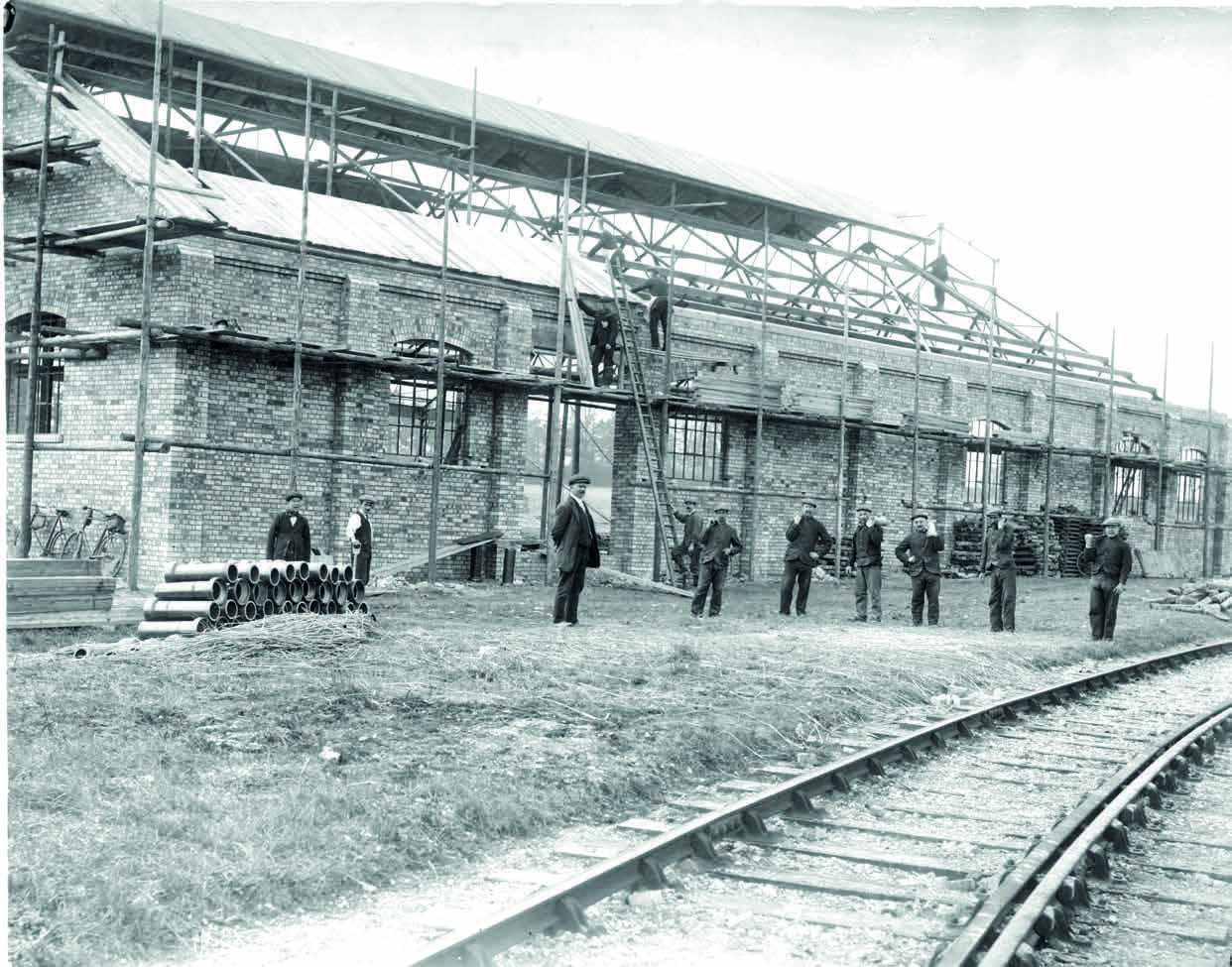
Housing programmes in the early twentieth century were meant to overcome shortages of dwellings for workers in many European industrial centres. Yet what was often overlooked was the fact that housing needed to be built by construction labour, and that labour also needed housing in order to be able to continue working. This article considers how housing scarcity intersected with the overlooked issue of labour scarcity: how the needs of construction workers were or were not addressed. It focuses on garden cities and related suburban settlements in England and Belgium – forms of development which, given their scale, required the mobilization of workers to remote sites, where workers often became the first occupants of what they were building.
The first section considers the earliest garden cities in the UK, designed by Raymond Unwin and his associates: Letchworth, founded in 1903 by Ebenezer Howard’s Garden City Association; and Gretna, developed by the Ministry of Munitions during the First World War to support weapons production. The second section focuses on the post-armistice British housebuilding programme, when local municipalities were granted special subsidies to provide dwellings for workers on large suburban estates. The third section looks at reconstruction efforts in the devastated Westhoek region of Belgium, led by Raphaël Verwilghen and the Dienst der Verwoeste Gewesten (Department of Devastated Regions).
In the British context, the contradictions in housing programmes were clearly articulated: cheap construction labour was needed for cheap dwellings, and this led to a paradox when the producers (workers) were also the consumers (residents). The underlying problem was that cheapness obscured actual costs. In Belgium, the connections were not so obvious: housing was promoted as a do-it-yourself activity, and even social housing was facilitated through a variety of special-interest groups. Nevertheless, in both cases, the unprecedented need for housing in both contexts prompted innovative efforts to house those who build.
Referenties
M. Tattara and P.V. Aureli, ‘The Home at work: A genealogy of housing for the laboring classes’, Harvard Design Magazine 46 (2018), 194-202.
L. Clarke and J. Janssen, ‘Forum: A historical context for theories underpinning the production of the built environment’, Building Research & Information 36 (2008) 6, 659-662.
C. Wall et al., Building a Community: Construction Workers in Stevenage 1950-1970, London 2011.
R. Patel and J.W. Moore, A History of the World in Seven Cheap Things, Oakland 2017, 18-22.
A. Toti, ‘Reform or revolution: Architectural theory in West Berlin and Zurich (1967-72)’, Architectural Theory Review 28 (2024) 1, 61-80; U. Weis, ‘Processes of changes in historical perspective: Technology and technique in the construction process 1919-1933 in Germany’, in H. Rainbird and G. Syben (eds.), Restructuring a Traditional Industry: Construction Employment and Skills in Europe, Oxford 1991, 67-88.
J.L. Plasky, Reforming Urban Labour: Routes to theCcity, Roots in the Country, Ithaca 2011, 8; P. Van den Eeckhout, ‘Brussels’, in: M. Daunton (ed.), Housing the Workers 1850-1914: A Comparative Perspective, London 2015, 69.
For example, M. Swenarton, Homes Fit for Heroes, London, 1981; J. Deraeve, J.M. Duvosquel, and M. Smets (eds.), Resurgam: De Belgische wederopbouw na 1914, Brussels 1985.
K. Marx, Capital: A Critique of Political Economy, Volume I, trans. S. Moore and E. Aveling, Moscow 1887, 763, www.marxists.org/archive/marx/works/1867-c1/ch32.htm.
E.P. Thompson, The Making of the English Working Class, Harmondsworth 1968, 9-11; E. Hobsbawm, ‘Working-class internationalism’, in F.L. van Holthoon and M. van der Linden (eds.), Internationalism in the Labour Movement, 1830-1940, I, Leiden/New York 1988, 3-16.
Plasky 2011 (note 6), 107.
Plasky 2011 (note 6), 88.
B. De Meulder et al., ‘Patching up the Belgian urban landscape’, OASE 52 (1999), 78-113; P. De Decker, ‘Facets of housing and housing policies in Belgium’, Journal of Housing and the Built Environment 13 (September 2008) 3, 155-171.
I. Bertels, ‘De uitvoerders op het terrein: Een braakliggend onderzoeksdomein’, in J. Cornilly (ed.), Bouwen aan wederopbouw 1914/2050: Architectuur in de Westhoek, Ypres2009, 175-191; M. Ball, Rebuilding Construction: Economic Change and the British Construction Industry, London 1988.
Thompson 1988 (note 9), 262-266; E. Hobsbawm, Labouring Men, London 1968, 321-371; J. Breuilly, ‘The Labour aristocracy in Britain and Germany 1850-1914: A review article’, Historische Zeitschrift (1986), 179-226.
M. Degraeve, ‘The business of city-building: Long-term change and continuity in the construction sector (Brussels, 1830-1970)’, Enterprise & Society 1 (2024) 32; E. Buyst, An Economic History of Residential Building in Belgium Between 1890 and 1961, Leuven 1992, 132.
R.J. Bennett and G. Newton, ‘Employers and the 1881 Population Census of England and Wales’, Local Population Studies 94 (2015), 29-49.
W.C. Baer, ‘Is Speculative Housebuilding Underappreciated in History?’, Urban History 34 (2007) 2, 296-316.
Plasky 2011 (note 6), 172.
E. Howard, To-morrow: A Peaceful Path to Real Reform, London 1898.
J.V. Tizot, ‘Ebenezer Howard’s garden city idea and the ideology of industrialism’, Cahiers victoriens et édouardiens 87 (2018).
Quoted by one of the founders of Letchworth Garden City, C.B. Purdom, The Garden City: A Study in the Development of a Modern Town, London 1913, 37.
Howard 1898 (note 19), 49.
R. Unwin, Nothing Gained by Overcrowding!, London 1912.
Purdom 1913 (note 21), 46.
‘Unemployed’, The Garden City: The official organ of the Garden City Association 1 (April 1905) 3, 32.
As expressed in the association’s monthly newsletter. E. Howard, ‘Who will help to build homes?’, The Garden City 1 (December 1906) 11, 237.
Howard 1906 (note 26).
‘Co-partnership in housing’, The Garden City 1 (1906) 10, 212.
C. Declercq, ‘The Odd Case of the Welcome Refugee in Wartime Britain: Uneasy Numbers, Disappearing Acts and Forgetfulness Regarding Belgian Refugees in the First World War’, Close Encounters in War 2 (2019), 5-26.
‘Notes’, Garden Cities and Town Planning 5 (June 1915) 6, 111.
J. Minet, ‘Government sponsorship of new towns: Gretna 1915-1917 and its implications’, in R. Rodger (ed.), Scottish Housing in the Twentieth Century, Leicester 1989, 104-124.
G.H. Duckworth, ‘Confidential: Notes of a visit on January 28th, 1916, to the government cordite factory at Gretna, now in course of erection’, Ministry of Munitions, 1916. National Archives MUN 5/158/1122/7/1.
S. Pepper and M. Swenarton, ‘Home front: Garden suburbs for munition workers’, Architectural Review June 1978, 366-376.
Pepper and Swenarton 1978 (note 33), 374.
R.B. White, Prefabrication: A History of its Development in Great Britain, London 1965, 37.
As frequently chronicled in the trade press. For example, a 1920 strike at Hayes, ‘Reducing output’, Illustrated Carpenter and Builder, 16 July 1920, 51.
‘Labour problems in the building industry’, The Builder, 23 April 1920, 507.
G.S. Cross, A Quest for Time: The Reduction of Work in Britain and France, 1840-1940, Berkeley 1989, 205.
W.S. Hilton, Foes to Tyranny: A History of the Amalgamated Union of Building Trade Workers, London 1963, 223.
Quoted in ‘The output of labour’, The Builder, 20 May 1920, 597.
For summaries, see White 1965 (note 35); M. Bowley, The British Building Iindustry: Four Studies in Response and Resistance to Change, Cambridge 1966.
‘What we think’, The Operative Builder 5 (December 1925) 1, 1-3.
Garden Cities and Town Planning 5 (March 1915), 3.
J. Maes, ‘De tuinwijk experimenten in het kader van de Belgische wederopbouw na 1918’, in: J. Deraeve, J.M. Duvosquel, and M. Smets (eds.), Resurgam: De Belgische wederopbouw na 1914, Brussels 1985, 189-202.
‘Rondreis in de Verwoeste Streken’, Het Volk, 4 October 1921.
A.J.V. Portielje, ‘Compte rendu du congrès organisé par la International Garden Cities and Town Planning Association, concernant la reconstruction de la Belgique’, Garden Cities and Town Planning 5 (April 1915) 4.
‘In de Verwoeste Gewesten’, De Ontvoogding July 1921.
L. Lootens, Rapport au sujet des méthodes de reconstruction des localités belges dévastées par la guerre, Brussels 1921.
Ministère de l’Intérieur, Bulletin de l’Office des régions dévastées (1921), 121. Quoted in J. Maes, ‘De tuinwijk experimenten in het kader van de Belgische wederopbouw na 1918’, in: J. Deraeve, J.M. Duvosquel, and M. Smets (eds.), Resurgam: De Belgische wederopbouw na 1914, Brussels 1985, 189-202.
Buyst 1995 (note 15), 132.
‘De Oorzaken der crisis in de bouwnijverheid’, De Ontvoogding November 1920.
Maes 1985 (note 49), 202.
R. Gobyn, ‘De woningnood en het probleem van de voorlopige huisvesting in België na de Eerste Wereldoorlog’, in Resurgam, Brussels 1985, 169-187.
‘In de verwoeste streken’, De Ontvoogding March 1921.
Maes 1985 (note 49), 202.
‘De Woningnood en de semi-permanente huisjes’, Het Volk, 25 December 1921.
‘Een rit aan het front’, Vooruit, 7 October 1921. Similar wages were common for unskilled as well as some skilled construction workers, according to De Ontvoogding.
According to statistics published in De Ontvoogding.
Bertels 2009 (note 13), 182.
‘Het bouwen van werkmanswoningen’, De Ontvoogding March 1921.
‘Industrie de la construction’, L’Habitation à Bon Marché (1923), 296.
F. Engels, ‘How Proudhon solves the housing question’, in The Housing Question, Moscow 1970, www.marxists.org/archive/marx/works/1872/housing-question/ch01.htm
C. Vandermotten and D. Istaz, ‘Cités-jardins et logement social à Bruxelles: L’exemple du Logis-Floréal à Watermael-Boitsfort’, Belgeo 2 (2024).
For example, D. Hill and M. Mazzucato, Modern Housing: An environmental common good, London 2024.
L. Guyon, ‘Shortage of labour in the construction industry’, European Construction Industry Federation Position Paper, Brussels 2023. www.fiec.eu/application/files/6216/9711/5277/2023-10-12_Shortage_of_Labour_in_the_Construction_industry.pdf
M.F. Reino, B. Brindle and C. Vargas-Silva, Migrants and Housing in the UK, Oxford 2024, 5; L. Hantson, L. Westerveen and I. Adam, Post-2014 migrants’ access to housing, employment and other crucial resources in small- and medium-sized towns and rural areas in Belgium, Brussels 2022.