Verstedelijking via betoncentrales of de vermarkting van cement als terraformingspraktijk: De Belgische case, 1955-85
Downloads
DOI:
https://doi.org/10.48003/knob.124.2025.4.875Gepubliceerd
Nummer
Sectie
Licentie
Auteursrecht (c) 2025 Tom Broes

Dit artikel is gelicentieerd onder de Naamsvermelding 4.0 Internationaal licentie.
Citeerhulp
Samenvatting
This article reconstructs how the development of a dense network of concrete plants was crucial in making concrete the basic material of an urbanizing construction culture. Belgium is treated as a paradigmatic case to argue that one – perhaps the main – reason why concrete became the most dominant building material in the world was due to the intensive way in which it was distributed and made available as a self-evident consumer product. The article describes how the relentless output of horizontal rotary kilns compelled the cement industry to adopt a bold 'politics of realization' – ensuring that massive cement volumes being produced actually found their way to the market. The solution lie in the development of a dense logistics network of concrete plants that efficiently produced and delivered ready-mix concrete directly to construction sites – actively shaping urbanization regimes capable of absorbing large volumes of concrete. Spurred on by cement giants CBR (Cimenteries et Briqueteries Réunies), CO (Ciments d’Obourg) and CCB (Compagnie des Ciments Belges), together with the establishment of the BVSB (Belgian Professional Association for Ready-Mix Concrete, 1962) and the IB joint venture (Inter-Beton, 1967), this strategy was increasingly formalized.
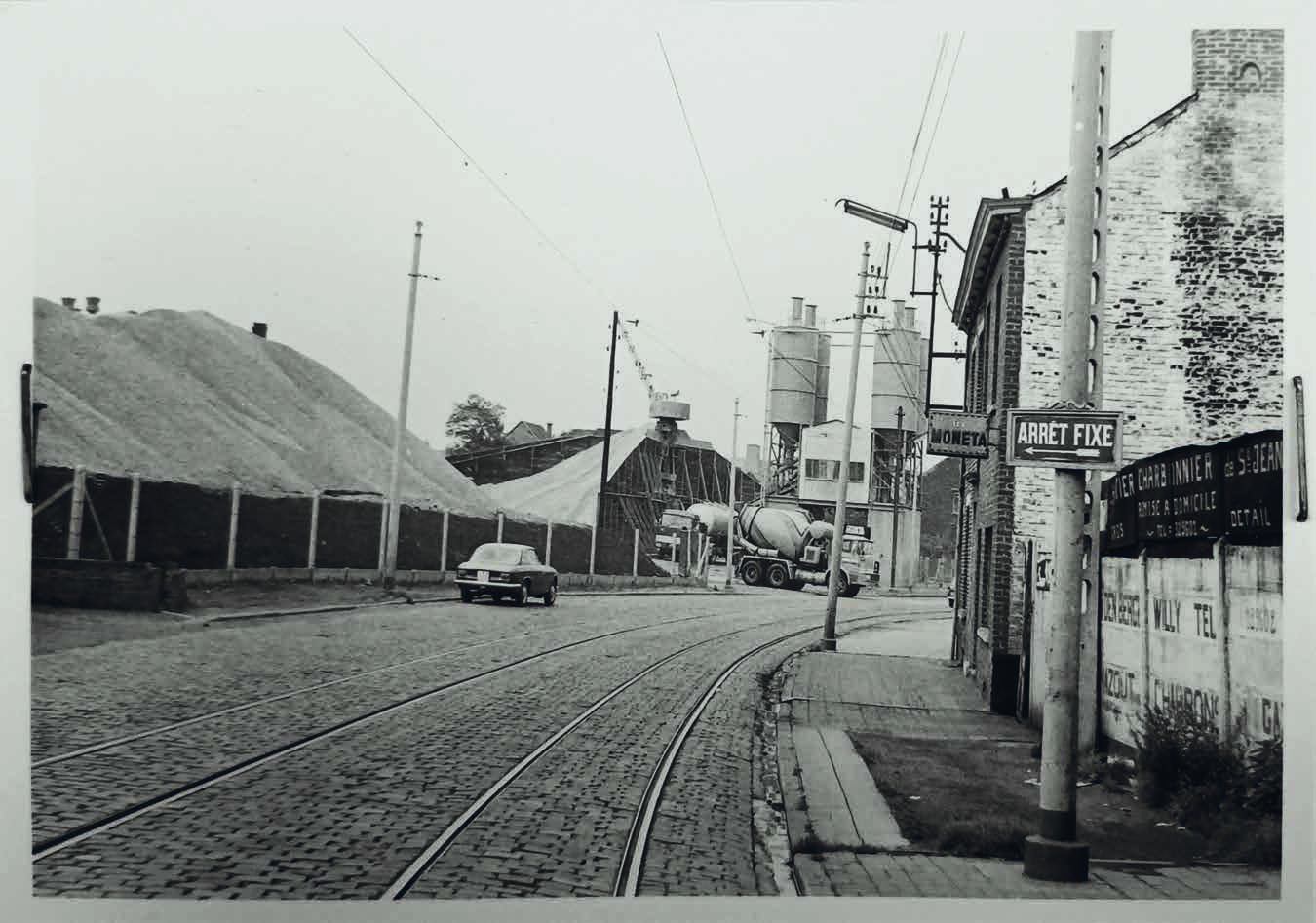
In the fragmented Belgian urban landscape, concrete plants spread rapidly across the entire country. During the 1960s and ’70s, this new concrete regime put a veritable form of ‘terraforming’ into practice. Important material flows of sand, water and gravel were rationalized and distributed in bulk to the concrete plants in the network. From there, concrete spread across the country, driving a surge in construction —from major infrastructure to everyday urban practices—that transformed the Belgian landscape.
As Belgium’s construction recession in the late 1970s deepened into a full-blown crisis in the early 1980s, the ready-mix concrete sector was sustained through major public contracts and a strategic pivot toward specialized concrete mixes that unlocked new niche markets. In this way, the concrete plant became increasingly entrenched as an indisputable cause of Belgian urbanization’s ‘cement addiction’. By focusing on the concrete plant, the article provides a new spatial perspective on the political ecology of concrete and raises questions about the sustainability of a building culture in which the overproduction and overcon-sumption of this extractive material is a structural component.
Referenties
D. Chakrabarty, ‘The climate of history. Four theses’, Critical Inquiry 35 (2009) 2, 197-222.
C.H. Nightingale, Our urban planet in theory and history, Cambridge 2024, 25.
C.N. Waters en J. Zalasiewicz, ‘Concrete. The most abundant novel rock type of the anthropocene’, in: D. DellaSala en M. Goldstein (red.), Encyclopedia of the Anthropocene. Volume I, Geologic history and energy, Oxford 2018, 75-85.
M. Gandy, ‘An urban political ecology of concrete’, Roadsides 11 (2024), roadsides.net/gandy-011/. Gandy verwijst naar: E. Dunford, ‘Cities are cutting emissions with an unlikely aid: concrete’, Smartcitiesdive, 23 november 2020. In de context van de Parijse periferie: M. Fernandez, C. Blanquart en E. Verdeil, ‘La terre et le béton. Le projet d’urbanisme consideré sous l’angle du métabolisme territorial’, VertigO – la revue électronique en sciences de l’environnement 18 (2018) 3, journals.openedition.org/vertigo/23302.
Editorial, ‘Concrete needs to lose its colossal carbon footprint’, Nature 597 (2021), 593-594; L. Allais en F. Meggers, ‘Concrete is one hundred years old. The carbonation equation and narratives of anthopogenic change’, in: D.M Abramson, Z.Ç. Alexander en M. Osman (red.), Writing architectural history. Evidence and narrative in the twenty-first century, Pittsburgh 2021, 75-89; K. Förster, ‘The kiln’, in: C. Howe, J. Diamanti en A. Moore (red.), Solarities. Elemental encounters and refractions, Santa Barbara (CA) 2023, 231-261. Vermeldenswaardige lopende onderzoeksprojecten: K. Förster, ETH Zürich: ‘A global history of cement. Building material of the Anthropocene’.
Een limitatief overzicht: A. Forty, Concrete and culture. A material history, Londen 2012; E. Elinoff, ‘Concrete and corruption. Materialising power and politics in the Thai capital’, City 21 (2017) 5, 587-596; A. Jappe, Béton. Arme de construction massive du capitalisme, Parijs 2020; V. Pivo, ‘Shrounded in dust. The unseen labor of African American cement workers’, Journal of Architectural Education 74 (2020) 2, 328-331; A. Helle en B. Lenherr (red.), Beyond concrete. Strategies for a post-fossil Baukultur, Zürich 2022; N. Magelhães, Accumuler du béton, tracer des routes, Parijs 2024; E. Elinoff en K. Rubaii (red.), The social properties of concrete, Santa Barbara (CA) 2025.
Een limitatief overzicht: O. Hatherley, The landscapes of communism. A history through buildings, Londen 2016; V. Grossman, A concrete alliance. Communism and modern architecture in postwar France, New Haven 2024; Y. Chen, ‘When concrete was considered sustainable. Ecological crisis, technological transition and the prefabricated concrete rural houses in Jiangsu Province from 1961 to the 1980s’, Built Heritage 8 (2024) 33.
Een limitatief overzicht: A. Choplin, Matière grise de l’urbain. La vie du ciment en Afrique, Genève 2020; R. Fivez, ‘A concrete state. Constructing materials and building ambitions in the (Belgian) Congo’, PhD diss. Universiteit Gent 2023. Vermeldenswaardige, lopende onderzoeksprojecten zijn: V. Pivo, University of Michigan, ‘A world cast in concrete. How the US built its empire’; M. Motylinska, Leibniz IRS: ‘Conquering with concrete: German construction companies as global players in local contexts’.
Een jaarlijks onderhoud niet te na gesproken.
Förster 2023 (noot 5).
D.W. Harvey, Abstract from the concrete, Berlijn 2017.
J.-L. Moreau, Bouwen om te blijven. Geschiedenis van de Belgische cementindustrie, Brussel 2020.
Het begrip ‘cementverslaving’ is ontleend aan: M. Motylińska en R. Fivez, ‘“Addiction to cement”. Narratives and strategies for tackling the lack of cement in sub-saharan Africa (1920s–1980s)’, ABE Journal 23 (2024) 27, journals.openedition.org/abe/16398.
VCN, De Belgische cementnijverheid, Brussel 1966; W. Vlassenbroeck, ‘De Belgische cementnijverheid’, K.N.A.G. Geografisch Tijdschrift VI (1972) 5, 461-68.
R. Hulpiau, De economische evolutie der Belgische cementindustrie tusschen 1920 en 1940, Antwerpen 1945.
P. Lambert, ‘Etude d’un problème de concentration dans l’industrie du ciment “Inter-Beton”’, masterthesis Université Catholique de Louvain, 1969.
J. Rassel-Lebrun, L’Emprise de la société générale et de la banque de Bruxelles, Brussel 1973; C. Herne, Comprendre son entreprise pour la reprendre. Les mécanismes de l’exploitation capitaliste vus à travers le cas de la Compagnie des Ciments Belges (CCB), Brussel 1984.
I. Cassiers, ‘“Belgian miracle” to slow growth. The impact of the Marshall Plan and the European Payments Union’, in B. Eichengreen (red.), Europe’s post-war recovery, Cambridge 1995, 271-291.
Fédération de l’industrie cimentière, L’industrie cimentère belge 1979, Brussel 1980.
Lambert 1968 (noot 16).
La technique routière was het driemaandelijks tijdschrift van de Vereniging van Belgische Wegencongressen (VBW, 1931) en het Opzoekingscentrum voor de Wegenbouw (OCW, 1952). D. Peleman, ‘Les hommes de la route. Engineering the urban society of the modern road in Belgium, 1899-1962’, PhD diss. Universiteit Gent, 2014.
R. Van De Wall, ‘Bouwen voor een onbekende toekomst. De totstandkoming van het Belgische autosnelwegennet (1935-1989)’, masterthesis KULeuven, 2007.
VCN, Cement, Brussel 1970, 74-75.
VCN, Basisstatistieken van de Belgische cementnijverheid 1975, Brussel 1976.
Het encyclopedische overzichtswerk van Stephanie Van de Voorde besteedt bijvoorbeeld geen bijzondere aandacht aan de opkomst van stortklaar beton: Stephanie Van de Voorde, ‘Bouwen in beton in België (1890-1975). Samenspel van kennis, experiment en innovatie’, PhD diss. Universiteit Gent, 2011.
VCN 1966 (noot 14), 6.
VCN 1966 (noot 14).
VCN 1970 (noot 23).
VCN, Basisstatistieken van de Belgische cementnijverheid 1972, Brussel 1973; VCN, De Belgische cementindustrie 1985, Brussel 1986; Febelcem, Jaarverslag Belgische cementnijverheid 2023, Brussel 2024.
Moreau 2020 (noot 12), 89.
Brussel, Belgisch Rijksarchief (BR), Depot Cuvelier (DC), Fonds CBR, Dossier 699, Note des Sociétés S.A. Cimenteries C.B.R. Cementbedrijven et S.A. Ciments d’Obourg sur une concentration dans l’industrie du béton préparé.
Voor een overzicht van de presidenten van 1962 tot nu: Fedbeton, Activiteitenverslag 2023, Brussel 2024.
Vereniging van betonmortelfabrikanten Nederland – Beroepsvereniging voor stortklaar beton België, Het pompen van beton, Brussel 1963.
Brussel, BR, DC, Fonds CBR, Dossier 1908, Organisation du Travail.
VCN 1970 (noot 23), 73.
Brussel, BR, DC, Fonds CBR, Dossier 2496, Le Marché du Béton Préparé.
Basisdata kwamen van het Nationaal Instituut voor Statistiek.
Brussel, BR, DC, Fonds CBR, Dossier 1328, Relations Béton Préparé Labos.
APBP, Prescriptions Techniques et Controle de la Qualité du Béton, Brussel 1962; APBP, Prescriptions Techniques pour l’Agréation des Centrales à “Béton Préparé’’, Brussel 1962.
Belgisch Instituut voor Normalisatie, Béton Préparé, Brussel 1965.
Het eerste Internationale Congres over stortklaar beton vond plaats in 1975. R.K. Dhir, Advances in Ready Mixed Concrete Technology, First International Conference on Ready-Mixed Concrete, Dundee, 1975, Oxford 1975.
Brussel, BR, DC, Fonds CBR, Dossier 3214, Procès Verbaux, Remarques générales et particulières faites au cours de nos sejours.
Lambert 1969 (noot 16).
Brussel, BR, DC, Fonds CBR, Dossier 698, Constitution Super-Béton [later Inter-Béton].
Brussel, BR, DC, Fonds CBR, Dossier 700, Proposition d’une politique d’investissement en agrégats.
Deze wetten hadden tot doel de regionale economische ongelijkheid te verminderen en de industrialisatie in achtergestelde regio’s te bevorderen. Zowel de oprichting van Inter-Beton zelf, als de uitbreiding van de grindactiviteiten ervan werd ondersteund, onder andere door middel van zeer gunstige leningen via de Nationale Maatschappij voor Krediet aan de Nijverheid. Het feit dat de cementindustrie steun kreeg, lijkt latere kritiek te bevestigen dat de wetten te veel topdown werkten, waardoor ze niet duurzaam aansloten bij noden van onderaf.
BR, Brussel, DC, Fonds CBR, Dossier 2446, Relations Inter-Béton – READY-MIX.
Collectief onderzoekscentrum van de cementsector en van de sector van het stortklaar beton in België.
Eerste Nederlandse Cement Industrie.
Onafhankelijke technische onderzoeksfirma.
Brussel, BR, DC, Fonds CBR, Dossier 1328, Relations Béton Préparé Labos.
Het valt buiten het bestek van deze tekst om hier dieper op in te gaan, maar CBR voerde een zeer actief beleid wat betreft opleiding van eigen personeel: Brussel, BR, DC, Fonds CBR, Dossier 1739, Formation du Personnel.
Lambert 1969 (noot 16).
M. Quet, Flux. Comment la Pensée Logistique Gouverne le Monde, Parijs 2022.
Van De Wall 2007 (noot 22).
CBR, ‘CBR resultaten 1972’, CBR ECHOS. Information pour le personnel 53 (1973) april-mei.
VCN 1976 (noot 24).
S.A. Amelinckx, Bien vivre dans son appartement, Brussel [196?].
L. Heindryckx, ‘Practices of Commodification. The Private Mass Housing Development of Etrimo and Amelinckx (1924-1985)’, PhD diss. Universiteit Gent 2023.
GB Entreprises, GB bedrijven jaarverslag boekjaar 1970. 10 jaar expansie – omzet 1960 1,5 miljard – omzet 1970 14,3 miljard, Brussel 1971.
Lambert 1969 (noot 16), 83.
Gesprekken met oudgediend personeel bij bezoek aan de betoncentrale in Sint-Pieters-Leeuw en Fedbeton, de huidige opvolger van de Belgische Beroepsvereniging voor Stortklaar Beton.
Voor een pertinente analyse van deze wetmatigheid in de context van verstedelijking en de bouwsector, zie: D.W. Harvey, The Urbanization of Capital, Oxford 1985.
CBR, ‘Le béton prêt à l’emploi’, CBR ECHOS. Information pour le personnel 94 (juni 1984), 5.
CBR, ‘Le béton prêt à l’emploi: tributaire de la crise... mais 1er client des cimentiers’, CBR ECHO. Information pour le personnel 97 (juni 1985), 4.
CBR 1984 (noot 64), 5.
BR, Brussel, DC, Fonds CBR, Dossier 2468, Travaux à Anvers.
CBR 1985 (noot 65), 4.
Brussel, BR, DC, Fonds CBR, Dossier 3211, Etudes du marché.
Brussel, BR, DC, Fonds CBR, Dossier 712, Publicités, études du marché.
Brussel, BR, DC, Fonds CBR, Dossier 3211, Etudes du marché.
C. Jencks, The language of post-modern architecture, Londen 1977.
Fedbeton 2024 (noot 32).
A. Bobbette en A. Donovan (red.), Political geology. Active stratigraphies and the making of life, Cham 2019.
Berekening gebaseerd op gegevens van Fedbeton en VOBN, de respectievelijke federaties voor stortklaar beton in België en Nederland, die spreken over 270 centrales in België (faba.be/niet-residentiele-sector/fedbeton) tegenover ruim 140 in Nederland (stutech.nl/index.php/organisaties-op-het-vakgebied-beton). Voor vergelijkingen in cementverbruik tussen beide landen, zie: VCN 1976 (noot 24); VCN 1986 (noot 29); Febelcem 2024 (noot 29).
Met de term ‘betonstop’ wordt in de Belgische en Vlaamse context gedoeld op het actief inzetten op een sterke vermindering van het bijkomend ruimtebeslag in een reeds erg versnipperd stedelijk landschap. Zie, bijvoorbeeld: K. Boussauw, ‘Wie zal de betonstop in Vlaanderen betalen? Van ruimtelijke gedifferentieerde vastgoedbelasting naar bouwcompensatiefonds’, in: G. Bouma, B. Boonstra en E. Vanempten (red.), Gedrag()en ruimte. Bijdragen aan de PlanDag 2018, Amsterdam 2018, 273-278.
G. Meyers, ‘Political ecology and urbanisation. Zanzibar’s construction materials industry’, The Journal of Modern African Studies 37 (1999) 1, 83-108; D. Williams, Stories in stone. Travels through urban geology, Londen 2009; J. Hutton, Reciprocal landscapes. Stories in material movement, Milton Park Abingdon Oxon 2019; K.L. Thomas, Building materials. Material theory and the architectural specification, Londen 2021.
K. Dawson, ‘Geologising urban political ecology (UPE). The urbanisation of sand in Accra, Ghana’, Antipode 53 (2021) 4, 995-1017; M.A. Miller, ‘A transboundary political ecology of volcanic sand mining’, Annals of the American Association of Geographers 112 (2022) 1, 78-96; Förster 2024 (noot 5).
Magelhães 2024 (noot 6).
Förster 2024 (noot 5).
Voor een volledig overzicht, zie: Gandy 2024 (noot 4).
In zijn boek Concrete and clay beschrijft Gandy een iconisch ongeval waarbij een viaduct uit gewapend beton instort onder het gewicht van een vrachtwagen die cement vervoert: M. Gandy, Concrete and clay. Reworking nature in New York City, Cambridge MA 2003. Magelhães legt uit waarom het wegdek veel sneller degradeert door een paar (te) zware ladingen, dan door grote massa’s éénpersoonswagens: Magelhães 2024 (noot 6).
A. Jacobs, J. Van Dessel en R. Dijkmans, Beste beschikbare technieken voor de betoncentrales en de betonproductenindustrie, Gent 2001.
Fedbeton, ‘De dode hoek. Onzichtbaar maar levensgevaarlijk’, www.fedbeton.be/de-dode-hoek-onzichtbaar-maar-levensgevaarlijk/.