Spaces of Materials Recovery
Downloads
DOI:
https://doi.org/10.48003/knob.124.2025.4.877Gepubliceerd
Nummer
Sectie
Licentie
Auteursrecht (c) 2025 Chiara Pradel

Dit artikel is gelicentieerd onder de Naamsvermelding 4.0 Internationaal licentie.
Citeerhulp
Samenvatting
Recently, the notion of material harvesting, collection, and reworking has gained significant attention as a crucial step in understanding essential aspects of building culture, particularly in relation to reuse, ma-terial scarcity, or, conversely, material availability. The ‘Recycling Beauty’ exhibition (Fondazione Prada, Milan 2022), which displayed Greek and Roman spolia, marble fragments, and pieces of sculptures placed alongside one other, alluded to practices of appropriation and possession, to the relationship between craftsmen and found resources, and to the need to store and preserve material in times of scarcity or political uncertainty. Similar questions have emerged in Dutch and Belgian contexts, for example, from research into the work of designer Marcel Raymaekers and his way of organizing salvaged materials (Marcel Raymaekers, pioneer in circular architecture, Vai, Antwerp 2023). Besides highlighting the relevance of practices linked to material reuse, exhibitions and installations also make clear by their very organization, how material collections take space and, at the same time, sculpt ever-changing landscapes.
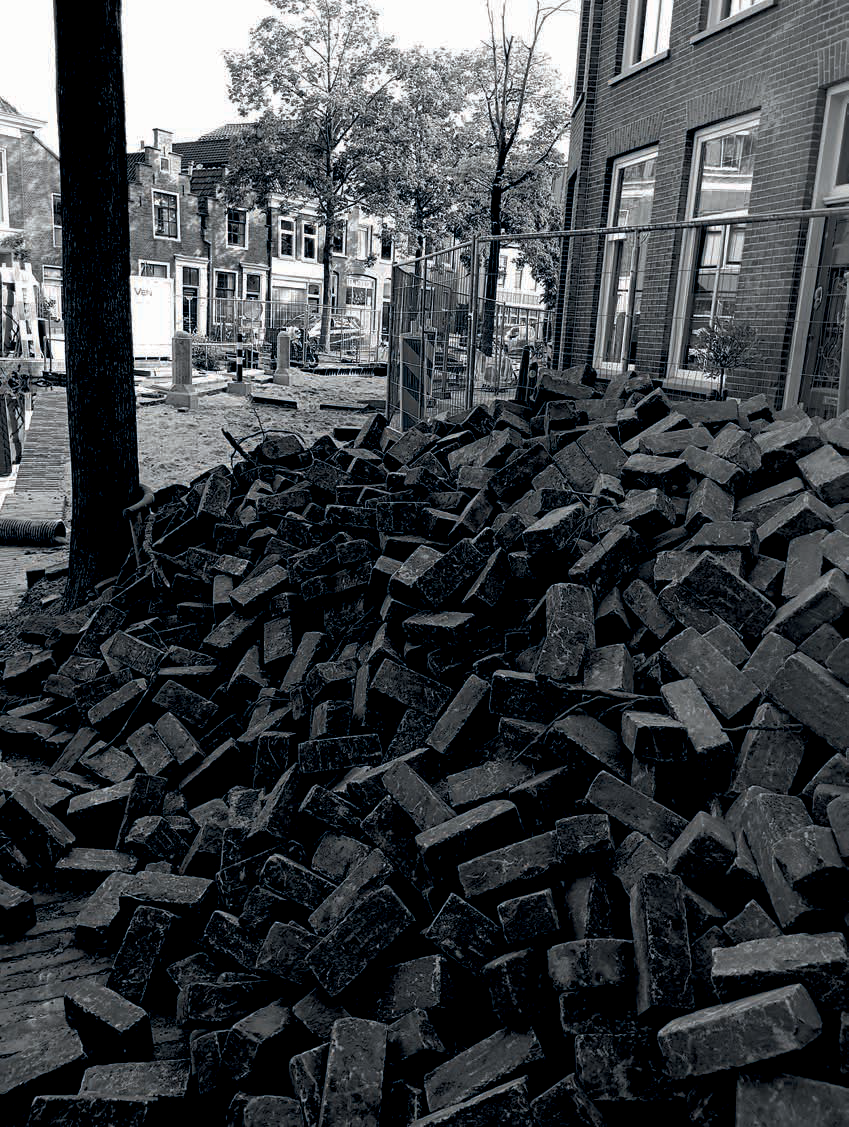
Building on these premises, and shifting the focus towards contemporary and less curated cases, this article critically examines the purpose, spatial qualities and configurations of three material storage typologies in the Dutch context – bricks and tiles, soil, and trees – highlighting their pivotal role in relation to material accessibility and availability. These sites, termed ‘material gardens’, are understood as experimental laboratories or ‘banks’, where the notion of availability is translated into the allocation and management of (material) reserves.
Though often overlooked and considered marginal, such open spaces are in fact key sites where design and other creative processes are crucially tied to resource allocation and disposal, and impact collective imagination and practices. They are increasingly being positioned at the core of construction and deconstruction processes, raising relevant ecological questions and helping to shape tacit knowledge on material reuse.
Referenties
‘Assemblages are ad hoc groupings of diverse elements, of vibrant materials of all sorts. Assemblages are living, informal, throbbing confederations that are able to function despite the persistent presence of energies that confound them from within.’ In J. Bennett, Vibrant Matter: A Political Ecology of Things, Durham/London 2010, 24.
The Weak Monuments research presents a collection of seemingly insignificant architectures and public spaces, whose political, social and architectural relevance is brought into relief through contrast. T. Říha, L. Linsi and R. Reema (eds.), Weak Monument: Architecture Beyond the Plinth, Zürich 2018.
S. Franceschini, N. Hirsch and S. Papapetros (eds.), Pre-Architectures, Leipzig 2024.
L.R. Lippard, Six years: The dematerialization of the art object from 1966 to 1972, Berkeley/London 1997.
J. Hutton, Reciprocal Landscapes: Stories of Material Movements, London and New York 2020.
According to Statistics Netherlands (CBS), the cost of building materials for new dwellings increased by nearly fifteen per cent in 2021 alone. The ‘Material intensity database for the Dutch building stock’ shows that the material intensity (which measures the quantity of materials used to produce a good) in ordinary constructions – in particular in most demolished categories of buildings such as utility buildings, offices built after the 1970s and postwar residential buildings – mostly consists of concrete and clays. B. Sprecher et al., ‘Material intensity database for the Dutch building stock: Towards Big Data in material stock analysis’, Journal of Industrial Ecology 26 (2022) 1, 272-280.
ec.europa.eu/eurostat/statistics-explained/index.php?title=Construction_producer_price_and_construction_cost_indices_overview.
See the Opalis map on professional dealers: opalis.eu/en/dealers/map
See, in particular, vb.nweurope.eu/projects/project-search/fcrbe-facilitating-the-circulation-of-reclaimed-building-elements-in-northwestern-europe/.
See, for instance, the EU Forest Strategy and commitment to planting three billion trees by 2030: eur-lex.europa.eu/legal-content/EN/TXT/HTML/?uri=CELEX:52021DC0572.
The project, under the leadership of Rotor, aims to develop an effective and replicable strategy for the development of reuse centres for construction materials. Two pilot projects are in France, one is in the Netherlands, in Utrecht. See preuse.nweurope.eu/.
According to Noortje Voulon, strategic adviser to the municipality of Utrecht, part of the plot is currently rented to another company (interview with the author, 29 August 2025). This helps to cover the expenses, as the project required several interventions to renovate existing buildings and adapt the site to its new function.
Banks often emerge in response to specific projects, like the development of new residential neighbourhoods and housing, with storage sites chosen from undervalued, nearby spaces.
‘Excavations form shapeless mounds of debris, miniature landslides of dust, mud, sand and gravel. Dump trucks spill soil into an infinity of heaps. The dipper of the giant mining power shovel is 25 feet high and digs 140 cu. yds. (250 tons) in one bite. These processes of heavy construction have a devastating kind of primordial grandeur and are in many ways more astonishing than the finished project—be it a road or a building. The actual disruption of the earth’s crust is at times very compelling, and seems to confirm Heraclitus’s Fragment 124, ‘The most beautiful world is like a heap of rubble tossed down in confusion.’ R. Smithson, Earthworks, New York 1968, 45.
Justus von Liebig used the term ‘metabolism’ to describe the exchanges of consumption and feedback that characterize biological systems. See J. von Liebig, The Natural Laws of Husbandry, New York 1863. Marx identified a fundamental disruption in the ecological relations between people and the material systems that support them, looking at the increasing divide between town and country. For a deeper understanding of the many implications of this idea in the urban context, see also: D. Peleman, B. Notteboom and M. Dehaene, ‘Fragments of a Changing Natural History of Urbanisation’, OASE 104 (2019), 1-11.
‘This adaptability is more than the flexibility to accept a new situation. It is stronger than mere acceptance…as these landscapes finally…become an object lesson in provisionality, undergoing continual modulation as they host transformative earthworks, mounds of debris, inert waste’ W. Kentridge, Six Drawing Lessons, London 2014, 88.
J. Hutton 2020 (note 5), 7.
For example, J. Hwang, ‘Generatinve Zoning: Mining the City Toward Novel Ecologies’, in N. Bouchard, Waste Matters: Adaptive Reuse for Productive Landscapes, Oxon 2021, 169-179.
The research project ‘Monumental Ground’ (2022), exhibited at the 19th International Architecture Biennale in Venice, maps the dislocation of millions of cubic meters of excavated inert material during the construction of the AlpTransit railway (1992–2020), and identifies, among others, the construction of ‘monumental walls’: artificial partitions or dykes made with excavated soil that have been displaced within the landscape.
According to Leon van Elzakker, project leader of the Grondbank GMG company, the operating radius of each bank for the collection and distribution of soil should not exceed about forty kilometers (interview with the author, 26 June 2025).
‘The primary raw materials used in construction, particularly coarse and fine sands, face challenges in terms of supply. The total extraction of regularly used primary raw materials ranges from 55 to 80 million tons, with backfilling sand accounting for approximately 66% of this activity. The supply of coarse aggregates, mainly sourced from Limburg in the southeastern part of the country, constitutes only 7% of the total supply, resulting in a significant demand-supply gap for coarse aggregates. To meet this demand, around 70% of coarse aggregates are imported from countries such as Germany, Belgium (Wallonia), Norway, Scotland, and the UK, often requiring transportation over distances exceeding 100 kilometers.’ See J. Hubert, F. Michel and L. Courard, ‘Sand resources in North West Europe’, in INTERREG NWE CirMAP (2024), 36.
The Testaccio Collective’s research project is entitled ‘De-Molire’ and is led by Eireen Schreurs, Chiara Pradel, Peng Lee. See: www.tudelft.nl/bk/onderzoek/projecten/material-culture-collective. The research, alongside other insights, underlines how transporting soil by boat to deposit sites offers significant economic and environmental savings. A single boat can carry over three thousand tons of soil, while a truck normally carries a maximum of twenty cubic metres.
A.G. Entrop, ‘Developments to come to a circular construction economy: Experiences in facilitating a local soil and sand depot’, in Earth and Environmental Science 855 (2021), 5.
Entrop 2021 (note 25), 7.
According to Sonja Dijkman-Elskamp, project supervisor with the municipality of Apeldoorn and responsible for the city’s circular banks, a new relocation of the soil bank is planned soon (interview with the author, 1 July 2025). The value of the municipal land hosting a grondbank may in fact increase over time making it economically disadvantageous to use it as a depot, or it may conflict with nearby urbanization projects. Furthermore, the space requirement for storing material tends to grow over time.
M. Gandy, Natura Urbana: Ecological Constellations in Urban Space, Cambridge MA 2022, 91-92.
The spontenous growth of vegetation on the mounds evockes Gilles Clément’s concept of the Third Landscape, in which abandoned parcels of land, that have been altered by human activity, evolve without deliberate human intervention. See J.D. Hunt, A World of Gardens, London 2012, 432-433.
See C. Pradel, ‘Tree Hubs: The city as a sustainable scenario of circular gardens and forests: The case of the Dutch Region’, Techne 29 (2025), 61-68.
C. Malterre-Barthes, ‘Maintenance as a Political Act’, in V. Grossman and C. Miguel, Everyday Matters, Berlin 2022, 197-198.
‘From a cost-saving perspective, you don’t always have to opt for reuse,’ says Matthijs Haveman, director of the Utrecht-based road construction company D. Van der Steen. ‘Economically, a new tile is cheaper, for example. It might cost 50 cents to make such a tile, and in that case, you don’t have costs for an intermediate storage site or transport to and from that location.’ However, Haveman emphasizes, ‘the depot is certainly more sustainable.’ K. Marée, ‘In the Utrecht raw materials depot, piles of stones and seesaw stand ready for reuse’, NRC, 19 March 2025, www.nrc.nl/nieuws/2025/03/19/in-het-utrechtse-grondstoffendepot-staan-stapels-stenen-en-een-wipkip-klaar-voor-hergebruik-a4886913.
‘Ethics bears on what, qualitatively, a process can do, and in what direction that capacitation leads. It evaluates the singular how of “an immanent power’s” mode of operation, as it consequentially unfolds. The project of a revaluation of values to give value its qualitative due takes the path of a processual ethics. Processual ethics is thoroughly relational. The immanently self-¬powering modes of existence it concerns come in multiples and mutually inflect. This qualifies it as an ecology, in the broadest sense’ B. Massumi, 99 Theses on the Revaluation of Value: A Postcapitalist Manifesto, Minneapolis 2018, 4.
‘Tracing materials back to the land can reveal how certain properties (the durability of certain wood or the shininess of a stone, for example) are not merely ‘useful’ attributes, but how they are physically related to unique, local biophysical conditions’. Hutton 2020 (note 5), 7.
See, for example, the research by Tanya Tsui, Cecilia Furlan, Alexander Wandl and Arjan van Timmeren, which defines spatial parameters for locating circular construction hubs in the Netherlands. T. Tsui et al., ‘Spatial Parameters for Circular Construction Hubs: Location Criteria for a Circular Built Environment’, Circular Economy and Sustainability (2024) 4, 317-338.
See H. Frei and M. Böhlen, Situated Technologies Pamphlets 6: MicroPublicPlaces, New York 2009, and the research by Tomas Ooms and by Studio Tuin en Wereld, Mike Viktor Viktor architects on Micro Public Material Depots: studio-tuin-en-wereld.tumblr.com/post/673898190114832384/mpmd-2043-awarded-bwmstr-label-027-the-micro.
Among other examples, it is worth mention here the ‘Holding Pattern’ installation by Tobias Armborst, Daniel D’Oca, Georgeen Theodore at MoMA PS1 in Queens, New York. See T. Armborst, D. D’Oca and G. Theodore, ‘Holding Pattern’, OASE 96 (2016), 19-23.
To make landscape public means to convey ‘the imagination of a new public, the assembling of new groups around specific spatial projects’. In this way, ‘landscape makes social developments tangible, and has the capacity to appeal to and make demands on the public’. M. Dehaene, B. Notteboom and H. Teers, ‘Making Landscape Public/Making Public Landscapes’, OASE 93 (2014), 7.
N. Milthorpe (ed.), The Poetics and Politics of Gardening in Hard Times (Ecocritical Theory and Practice), London 2019, 8.
K. Moe, ‘Metabolic Rift, Gift, and Shift’, in N. Axel et al. ‘Accumulation: The Art, Architecture, and Media of Climate Change’, Minneapolis 2022, 306.
K. Moe, 2022 (note 40), 308.